


 PT
PT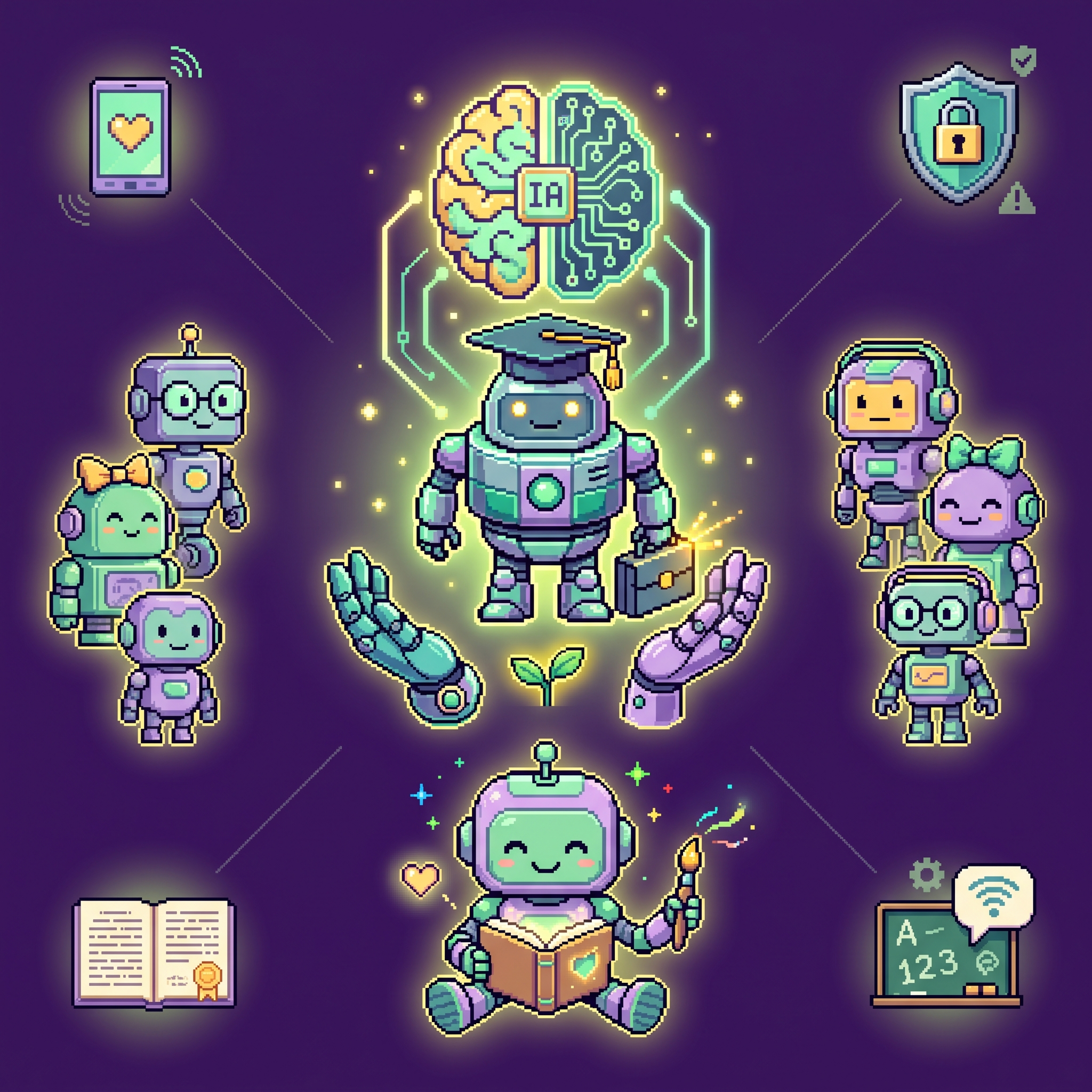
A Stanford study reveals that generative AI is changing the supply of jobs open to automation, in tasks such as customer service, writing and programming.
By José Brito — journalist, founder of Pupa Educação Digital and teacher at the AI and Digital Education Lab of Colégio MOPI.
“The AI law needs to address the training of the workforce, not only the risks. Young people are already finding it hard to get positions in the market. These numbers show up in surveys in the United States, showing a decline in the hiring of young people in areas exposed to AI.”
Ronaldo Lemos — lawyer, co-founder and chief scientist of ITS Rio, in an interview with CBN Notícias.

[Cover image] Pixel-art robot in a graduation cap holding a briefcase, under a brain that is half orange, half green circuitry, marked “AI”.
I grew up watching the so-called American dream take shape as if it were a lost paradise packaged for travel. From cinema screens to the endless lines for visas and passports. The idea of packing your bags, crossing borders and building a life to the rhythm of the American Way of Life moved whole generations. I have many friends who went to live outside Brazil. And that is all fine.
What has changed now is the entrance door to that dream: the first job. A recent study from the Stanford Digital Economy Lab shows that employment among workers aged 22 to 25 in the occupations most exposed to generative AI is today 19% below where it would be had it tracked that of their less exposed peers.
I went looking for that figure after an interview I heard with Ronaldo Lemos on CBN radio. What struck me most is that the fall comes less from layoffs and more from hiring that has simply stopped happening — at least seen from a certain angle. Ronaldo talks about law firms that now think twice about taking on an intern who may need up to two years to become an associate, or handing the task instead to the tokens of a generative AI model.
This geopolitical board is shaking some of the pieces that move the industry today. Roles once concentrated in a few countries have gone global and, with them, changes in culture, conflicts between generations and digital transformation. I see all of it day to day. With students at the school’s AI and digital education lab, and with adults who, like me, went back to studying: we all feel that the world of work has been rewritten, but few know where to start again.
In Brazil, data from IBGE, the national statistics institute, put youth unemployment at around 11% to 12%, practically double the national average, which hovers near 6%. Which means that, curiously, some doors are closing because of technological advance and others because of how slow we are to qualify teams for the digital universe.
There is a sentence I repeat at talks and events: it is not AI that will take your job, it is someone who might be sitting right next to you and has learned to use it better than you have. And it happened to me. I trained as a journalist and reinvented myself at the frontier between education, media and technology, studying AI and data when I already had plenty of road behind me in the profession.
There is a vacuum in the middle of the road today. On one side, a group of specialists and professionals with traction in technology. On the other, a flood of AI trends on social media that excite people but do not train them.
It is in that intersection — a slice of the population hungry for knowledge and somewhat forgotten by the market — that Pupa works. Three fronts: PUPA EDU, which trains people and families in digital education; PUPA MAX, which takes applied AI to teams and companies; and PUPA LAB, which turns all of it into immersive experiences about digital culture.
Let’s go together! I’ll be expecting you from September 3. Enrollment is open!
🔗Source: Curso IA no dia a dia, Jornal da CBN e Stanford Edu

#1 — Pupa launches a new open course on applied AI for young people and adults. Enrollment open until September 2
The program will feature live online sessions on YouTube, support materials for asynchronous study, and a focus on hands-on first steps with the technology.
🔗Source: Sympla
#2 — Instituto Alana survey on teenagers and screens reveals what young people want from a better internet
The study heard from teenagers aged 13 to 17 about the digital ecosystem, and half of them say they spend more time online than they should.
🔗Source: Jornal do Commercio, Instituto Alana e Criativos da Escola
#3 — Brazil’s data protection authority suspends live streams on Discord until the company proves its safeguards under the Digital Child and Adolescent Statute
Data from SaferNet show that between January and July 2026 reports involving Discord rose 54%, with cases of harassment, incitement to self-harm and suicides.
🔗Source: G1
#4 — Anthropic adapts to European legislation and launches a watermark for content generated by Claude
The measure applies to models released in the EU from August 2 and will also be extended across the whole Claude product line and partner cloud platforms.
🔗Source: UOL e Canaltech
#5 — Researcher Paulo Blikstein is the guest on the next Roda Viva, on education and technology
The director of the Lemann Center for Brazilian Studies assesses the impacts of AI on teaching and learning practices, as well as the transformations in the education of children.
🔗Source: Cultura
READING PICK 📚
Book: Tecnologias da invenção: inteligência artificial, criatividade e arte (Technologies of Invention: artificial intelligence, creativity and art)
Authors: Dora Kaufman and Giselle Beiguelman
Publisher: Autêntica
Year: 2026
Published in Brazil only, in Portuguese.
And there is a new release this week. Here in Rio de Janeiro I will be at Shopping Leblon next Wednesday, the 19th. I got the invitation from Professor Dora Kaufman and have already confirmed. In her column this week in Época Negócios magazine, Dora warns about the risks of speculation over a future, not far off, in which machine intelligence matches or even surpasses human intelligence. In the book the authors refuse any simplistic approach to the subject. If, on one side, more naive views treat technology as a magic shortcut, on the other there are people forecasting catastrophe and seeing it as the end of human authorship. Worth reading! They trace the history of the concept of creativity, from psychology to neuroscience, and read what has been achieved with AI in the light of the philosophy of technology and the history of art.

Cover of Tecnologias da Invenção: inteligência artificial, criatividade e arte, by Dora Kaufman and Giselle Beiguelman (Autêntica, 2026). The red title on a white ground sits alongside an abstract composition of lines, circles and dots that suggests an expanding algorithmic diagram.

Thank you for reading Radar Pupa, a newsletter from Pupa Educação Digital. If it makes sense for you, subscribe for free to receive the next editions, and feel free to share these notes on digital culture, news and AI in education.
Preparing people and organizations for digital culture, with strategy and learning.
» SUBSCRIBE ON WHATSAPP!
» pupaedu.digital