


 PT
PT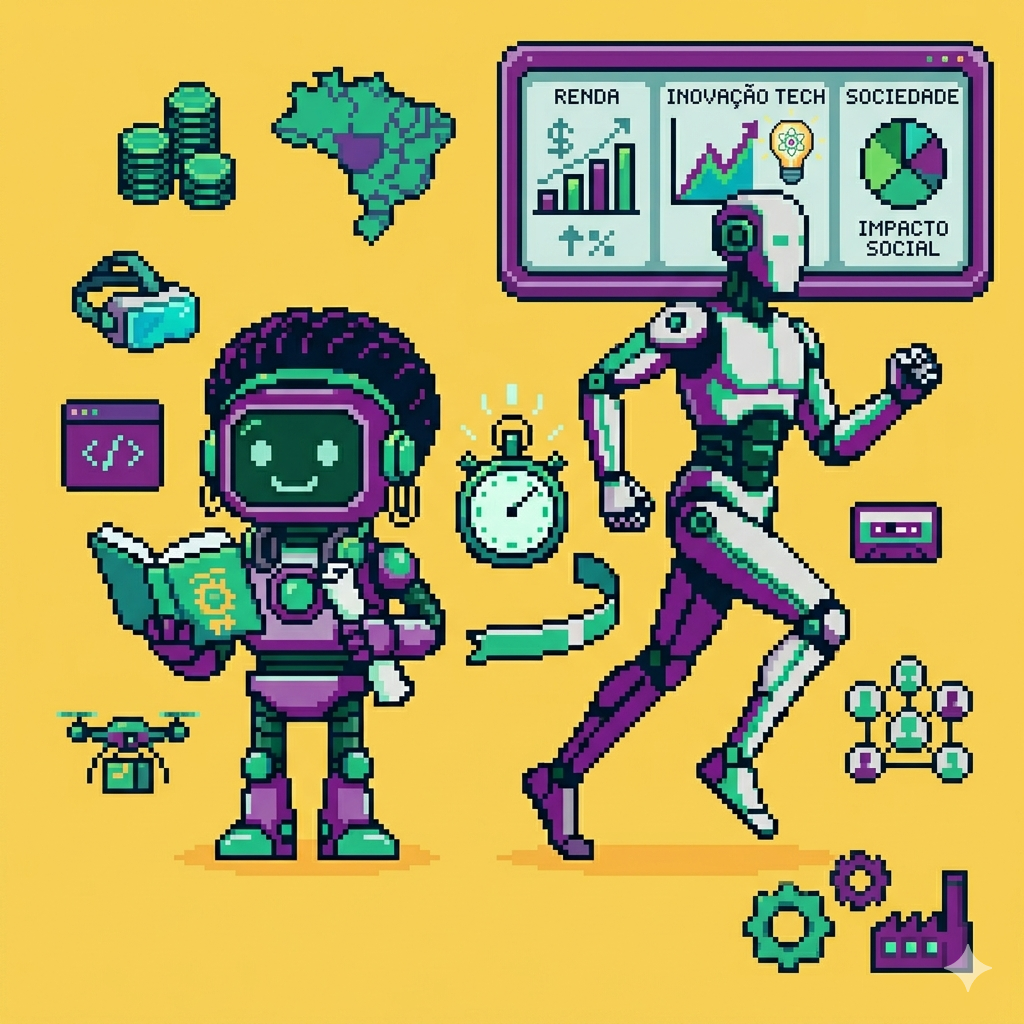
Brazil’s largest study on vocational education finds 91% optimism among young people who juggle work, school and tight budgets — and who still say the classroom makes a difference.
By José Brito, journalist, Founder of Pupa Educação Digital and faculty at the AI and Digital Education Lab at Colégio MOPI.
“In our daily school life, we see that many students arrive at vocational education
driven by the desire to build a better future, even as they face very concrete
challenges — financial pressure, the need to study and work at the same time, and,
in many cases, gaps in their previous education.”
Fernanda Yamamoto — Head of Research and Innovation in Vocational and Secondary Technical Education, SENAC São Paulo. Panorama EPT, 2026

AI-generated image with Gemini. Pixel-art illustration on a warm yellow background. On the left, a compact robot with a purple Afro and a green facial screen smiles while holding an open book. On the right, an athletic humanoid robot runs in a dynamic pose, with a panel of charts behind it showing income, tech innovation and social impact. Between them, a shining stopwatch. Around them: stacked coins, a map of Brazil, a cassette tape, gears, a drone and icons for networks and technology.
I first met Fernanda Yamamoto in an online meeting with other researchers and professionals working at the crossroads of digital culture, innovation and youth. An associate researcher at the University of São Paulo (USP), with a PhD in Education, Art and Cultural History, she currently coordinates educational projects and conducts research at SENAC-SP, focusing on curriculum design and teacher training for vocational education.
We crossed paths again last March, during the launch of Panorama EPT — a first-of-its-kind study that surveyed more than 32,000 students, course coordinators and teachers across 61 SENAC units and 48 technical programs in the state of São Paulo.
The research will follow these students for five years — from 2026 to 2030 — measuring the real impact of vocational training on employability and social mobility. At a time when “skills for the future” has become shorthand to land any job, paying attention to what actually moves this generation could point the way to new public policies for young people.
The numbers tell a striking story. More than 90% of these students describe themselves as optimistic or very optimistic about their professional future. 96% say school makes a difference in their lives. And 81% of those enrolled in technical high-school programs plan to work and study at the same time after they finish. This is not a carefree generation. It is a generation with goals. As Fernanda told me, they show up driven by the desire to build a better future, even as they face financial pressure, gaps in earlier schooling, and the daily juggle of work and study.
This same week, the “Anti-Enzo Test” went viral as nostalgia in Brazil. The name pokes fun at “Enzo” — a stand-in for the youngest Gen Alpha kids in Brazil who have grown up with a smartphone in hand. The test asks pop-culture and practical-knowledge questions from the analog era. But what it reveals goes beyond the joke: there is something missing in the upbringing of a generation that has never had to wait for a song to play on the radio just to record it on a cassette, never picked a film without reading dozens of reviews first, never learned to make something work with imperfect tools. Resilience and improvisation. That capacity to wing it, to wait, to read the world with a bit more caution — those may be exactly what sets someone apart in a labour market that automates more of itself every month.
In that sense, the analog world still produces knowledge the algorithm cannot. And the vocational and technological education that Panorama EPT maps out is, in many ways, a response to that gap. The numbers are worth digging into. They put young people in direct contact with a working world that keeps changing — and changing, and changing — but never stops needing the one thing only human experience can offer: care.
Source: Panorama EPT SENAC São Paulo, 2026 and SENAC São Paulo Press Room.
Check out the other highlights of the week and the reading recommendation below! 😉

#1 The Anti-Enzo Test: a meme that became a generational mirror
What can a viral challenge testing knowledge from the analog era tell us about society, pop culture and how the youngest among us access information?
#2 R$30 million for cultural projects: applications open through May 15
The 2026 open call from Instituto Cultural Vale will channel R$30 million through Brazil’s Rouanet cultural-incentive law for projects in performing arts, music, audiovisual, heritage and more.
Source: Instituto Cultural Vale.
#3 Dora Kaufmann: Brazil’s cultural diversity is at risk in the age of AI
In a recent article, the PUC-SP researcher warns about large language models trained on cultures from the Global North — and the threat this poses to creative production in Portuguese.
Source: LinkedIn.
#4 Itaipu Parquetec takes the future-of-work debate to 21 cities across Paraná and Mato Grosso do Sul
In partnership with Itaipu Binacional, the “Future of Work” seminar series brings together young students to discuss AI, technology and employability.
Source: Itaipu Binacional | Flickr.
#5 Humanoid robot beats human world record at Beijing half marathon
The Lightning humanoid, developed by Chinese tech company Honor, finished the 21-kilometre course in 50 minutes and 26 seconds — beating the human world record by more than six minutes.
Sources: Exame | CNN | Olhar Digital.
READING RECOMMENDATION 📚
My Backyard Is Bigger Than the World (O meu quintal é maior do que o mundo)
Author: Manoel de Barros
Publisher: Companhia das Letras
Year: 2015
