


 PT
PT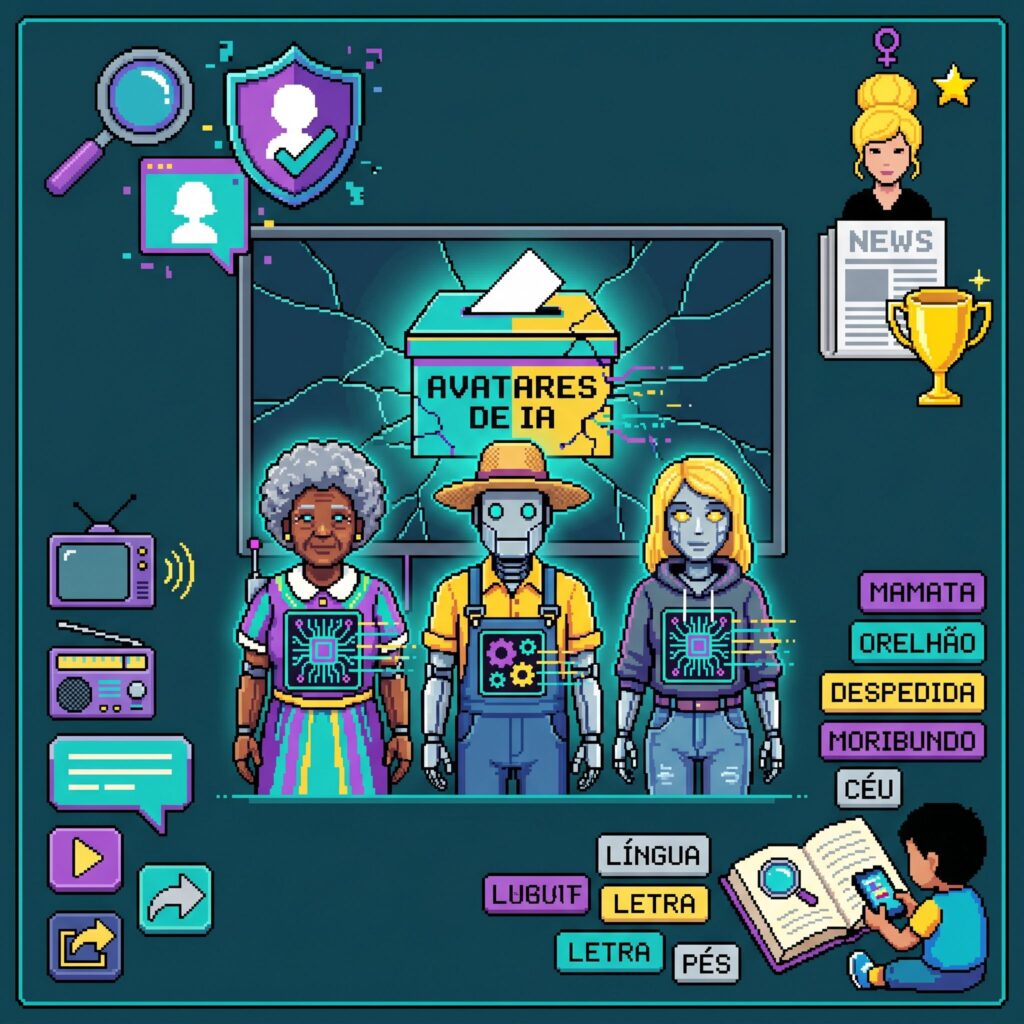
Synthetic avatars are testing political messages and challenging AI oversight. Brazilians are among the populations most exposed to them — and the least equipped to tell the difference, a new study says.
By José Brito, journalist, Founder of Pupa Educação Digital and faculty at the AI Lab at Colégio MOPI.
“Until about two years ago, people thought they could spot deepfakes because the videos showed people with six fingers, a missing ear, that kind of thing. People got used to those tells — but today they barely exist anymore.”
Andrea Rozenberg — Director for Emerging Markets, Veriff. Quoted in O Globo, May 2026, “AI that fools: Brazilians can’t identify deepfakes despite heavy exposure to synthetic video.”

AI-generated image with Gemini. Pixel art on a petrol-green background. Three humanoid robots — an older Black woman, a farmer and a young blonde woman — display circuit boards on their chests, with the label “AI AVATARS” appearing on a ballot box in the background, set against a cracked screen. Around them: icons for TV, radio and social media; the Brazilian Digital Child Statute (ECA Digital) shield; a Pulitzer trophy paired with a blonde female figure and the ♀ symbol; and Portuguese words alongside a child reading while holding a mobile phone.
Two news stories in O Globo this week caught my eye. The first, by Rafaela Gama, drawing on data from Sonar — A Escuta das Redes (a social-listening initiative), carries a title that sounds straight out of a film or a streaming series: “Avatar Wars.” The second, by Bruno Romani, brings a more revealing data point about what is heading our way in this election year. According to research by Veriff, a tech company specialising in digital identity verification and online fraud prevention, 80% of Brazilians have already come across deepfakes online — well above the international average of 60%. And here is the part that matters most. The concerning figure is not exposure: it is detection. Only 29% can spot when a video is fake, and only 35% correctly recognise a real one.
This difficulty in telling real from synthetic can no longer be put down to inattention. We’re looking at a new phenomenon. Technology is moving fast and, with it, the line between what is real and what is generated keeps blurring. As Andrea Rozenberg, of Veriff, explains, until about two years ago people relied on visual tells — six fingers on one hand, a missing ear, hair glitches, lighting that didn’t add up. Those rough edges are gone.
This is the backdrop for the so-called “Avatar War.” Over the past few weeks, characters like “Dona Maria,” an elderly Black woman who criticises the Lula administration, and “IAsmina,” a young blonde woman with a Minas Gerais regional accent posting about falling unemployment in Brazil, have surfaced online. They are just two of many AI-generated political personas now driving lawsuits and behind-the-scenes complaints across Brazilian politics.
Enter a new concept: synthfake. These are videos that mark the next frontier of disinformation — the type of content that is hardest of all to regulate, detect or address through media literacy. The familiar deepfake — AI-generated media that manipulates or swaps the image, voice or expressions of a real person — is now blending with content entirely generated by AI, not necessarily anchored to a flesh-and-blood human at all. It just got harder.
A piece of the democratic process — of listening, of persuasion — is being replaced by simulation. The contest is no longer simply about which message or platform best resonates with voters. Now it is a race for engagement speed with avatars, for their direct impact, and for whatever this synergy with different voter profiles can produce. The key is the simulation of grassroots authenticity. And once again, we face the paradox between who we are, how we want to be seen, and what others think of us through the tools we use.
That same week, I heard on my favourite podcast, Foro de Teresina (from Piauí magazine), that CGI.br — Brazil’s Internet Steering Committee — has reported that internet platforms are now the main way Brazilians access information, surpassing radio and television. Look at that. Confirming, precisely, that the environment where these avatars circulate is the exact place where most Brazilians now form their opinions. The fact-checking outlet Agência LUPA has documented that the first 30 days of the new Digital Child Statute (ECA Digital) were dominated by alarmist narratives and coordinated disinformation campaigns on social networks and messaging apps. In response, the government raised YouTube’s age rating in Brazil from 14 to 16, heavily influenced by AI-generated “fruit soap operas” that went viral among children and teens. And a first-of-its-kind OECD study has mapped the impact of screen time on the learning of 5-year-olds in Brazil, finding that 53% of families rarely read to their children.
For a bit of comfort, a small light at the end of the tunnel. This week the 2026 Pulitzer Prize for Public Service went to The Washington Post for a series of investigations by Hannah Natanson — one of the journalists Donald Trump has personally targeted. It might sound redundant, but the news always reminds me why we are still here. Good journalism still exists, still resists, and still makes a difference.
Sources: Avatar Wars — O Globo / Rafaela Gama | AI that fools — O Globo / Bruno Romani | Veriff — Brazil deepfakes study | CGI.br — Internet platforms surpass radio and TV | Agência LUPA — ECA Digital | YouTube age rating raised — G1 | Pulitzer 2026.
Check out the other highlights of the week and the reading recommendation below! 😉

#1 Internet overtakes radio and TV as Brazil’s main source of information
Digital platforms are now the primary way Brazilians access news and information. The finding helps explain why electoral avatars spread so effectively.
Source: CGI.br.

#2 First-of-its-kind OECD study reveals how screens shape the learning of 5-year-olds
A survey on early childhood conducted in São Paulo, Ceará and Pará brings new data on literacy, numeracy, social-emotional and executive-function skills.
Sources: Estadão | Agência Brasil.
#3 ECA Digital: disinformation, coordinated campaigns and a YouTube rating change mark the law’s first month
Agência LUPA’s observatory tracked alarmist narratives and coordinated campaigns against the new legislation. The government raised YouTube’s age rating to 16.
Sources: Agência LUPA | G1.
#4 At Bett Show Brazil, experts point to a coming-of-age moment for edtech
Education leaders argue that Brazil’s edtech ecosystem is no longer dazzled by silver-bullet solutions. Read the full piece.
Source: Bett Show Brasil.
#5 Journalist targeted by Trump wins the 2026 Pulitzer Prize for Public Service
The Washington Post series exposed the impact of federal cuts to US agencies during the first months of the new administration.
Source: G1.
READING RECOMMENDATION 📚
Aos Pés da Letra (By the Letter)
Author: Gregorio Duvivier
Publisher: Companhia das Letras
Year: 2026

I bought tickets to take my family to see Gregorio’s play O Céu da Língua (“The Sky of Language”). Through twists of fate, I haven’t managed to catch a performance yet. So I gave in and bought the book instead. Pure Brazilian essence, distilled with the very thing that has brought us this far: our language. The reading is light, smart and timely. Anyone who understands how words work — where they come from, what they carry, even how they can be used to manipulate a society — holds a tool no synthetic voter can replicate: critical analysis, and the ability to get the joke. Onward we go, because everything would be funnier if it weren’t so tragic.
Thank you for reading Radar Pupa, a weekly newsletter from Pupa Educação Digital. If it speaks to you, subscribe for free to receive future editions, and share these notes on digital culture, news and AI in education.