


 PT
PT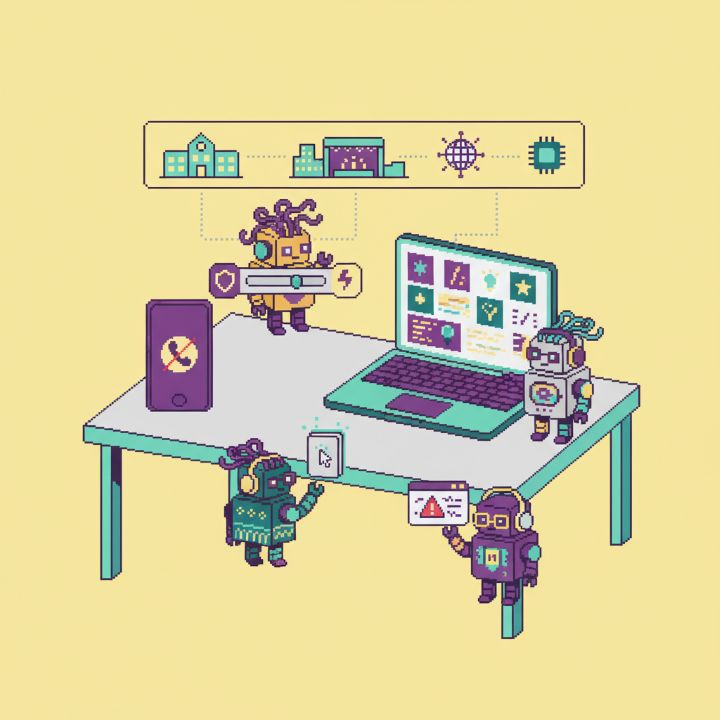
Access, creativity, and diverse voices prove algorithmic fluency is here to stay
Hey folks, I’m a little late this week—but here we are. Let’s go!
By José Brito, journalist and founder of Pupa Educação Digital
“I worry about excessive screen time, but I also worry about fear of something that’s already part of life, part of the world—a language that must be learned. (…) The absence of screens in the classroom also has negative effects on education.”
Fábio Campos, educator
The last time I met with educator Fábio Campos, it was over a friendly feijoada at Porto Amigo Bar, a traditional spot nestled in Rio’s bustling gastronomic hub of Botafogo. A touch of spicy malagueta pepper and a shot of cachaça Salineira completed the ritual. We spoke about recent studies tied to Federal Law No. 15.100/2025, which restricts mobile phone use in schools and was signed into law on January 13 this year.
Over dessert, we remembered how Rio de Janeiro led this movement with Decree 53.918/2024, enacted by then–Education Secretary Renan Ferreirinha. But this also led us to a more nuanced question: How are schools, teachers, families, and students actually dealing with this a few months in? How has limiting access to digital devices affected how tech is discussed—or not discussed—in the classroom?
As a parent, educator, and media & information specialist, I fully recognize the benefits of greater focus, classroom engagement, and improved social interaction without the distraction of screens. There’s something timeless about recess unplugged.
Yet we can’t shy away from our responsibility to teach digital fluency. We must embrace the benefits of these tools for a generation wired for connection, driven by new content models, and deeply shaped by AI-native logic. Education needs to keep pace—with supervision, ethics, diverse perspectives, and moderated content. Like science itself: trial and error, iteration and growth. With care, not bans.
Before the bill came, Fábio wrapped up with sharp insights alongside other thought leaders like Judge Vanessa Cavalieri, pediatrician Daniel Becker, Mariana Cinelli (from the Disconecta Movement), and psychiatry professor Guilherme Polanczyk from USP.
Let’s dive into this week’s picks!
Photo: O Globo

#01 Balancing Tech Risks and Digital Literacy
Read more: [O Globo]
Alternative version [no paywall]

Link: [Festival Hacktown]
Link: [Socialab]
Link: [Superinteressante]
Link: [OpenAI]
If you’re a fan of classic almanacs or those old-school publications packed with practical tips and quirky facts — like Shell Responde or the nostalgic Guia 4 Rodas (shoutout to anyone who lived through the 1980s) — or if you’re into digital reading recs from profiles like @book.ster by Pedro Pacífico, then this one’s for you.
This is a contribution from a trio I admire: Victor Vicente, Paulo de Camargo, and Januária Cristina Alves. Their book rides the wave of the digital revolution. It explores how technology is driving social and scientific advances, the link between computational and mathematical thinking, and the importance of privacy, autonomy, and digital curation. It even offers practical tips to avoid online scams and opens our minds to our digital rights and responsibilities. It’s about citizenship, social justice, and diversity.
This work is currently under evaluation for Brazil’s National Textbook Program and is designed for high school students — those right at the heart of that wild and swirling ecosystem we call the digital and media universe. Also known, fittingly, as algorithmic literacy.
Goodbye tube TVs, hello wireless phones, welcome digital influencers. And so we go, leaving behind data traces and digital footprints, navigating new interfaces, programming languages, and doing our best to use platforms ethically and responsibly — in search of more human, meaningful digital experiences. Almost like chasing our own Neverland.
Where did this conversation even start? No clue. But one thing’s for sure: there’s nothing like a good guide when you’re trying to find your way.
» Saraiva Identity – Digital Education
Authors: Januária Cristina Alves, Paulo de Camargo e Victor Vicente
Publisher: Editora Saraiva
2025
