


 PT
PT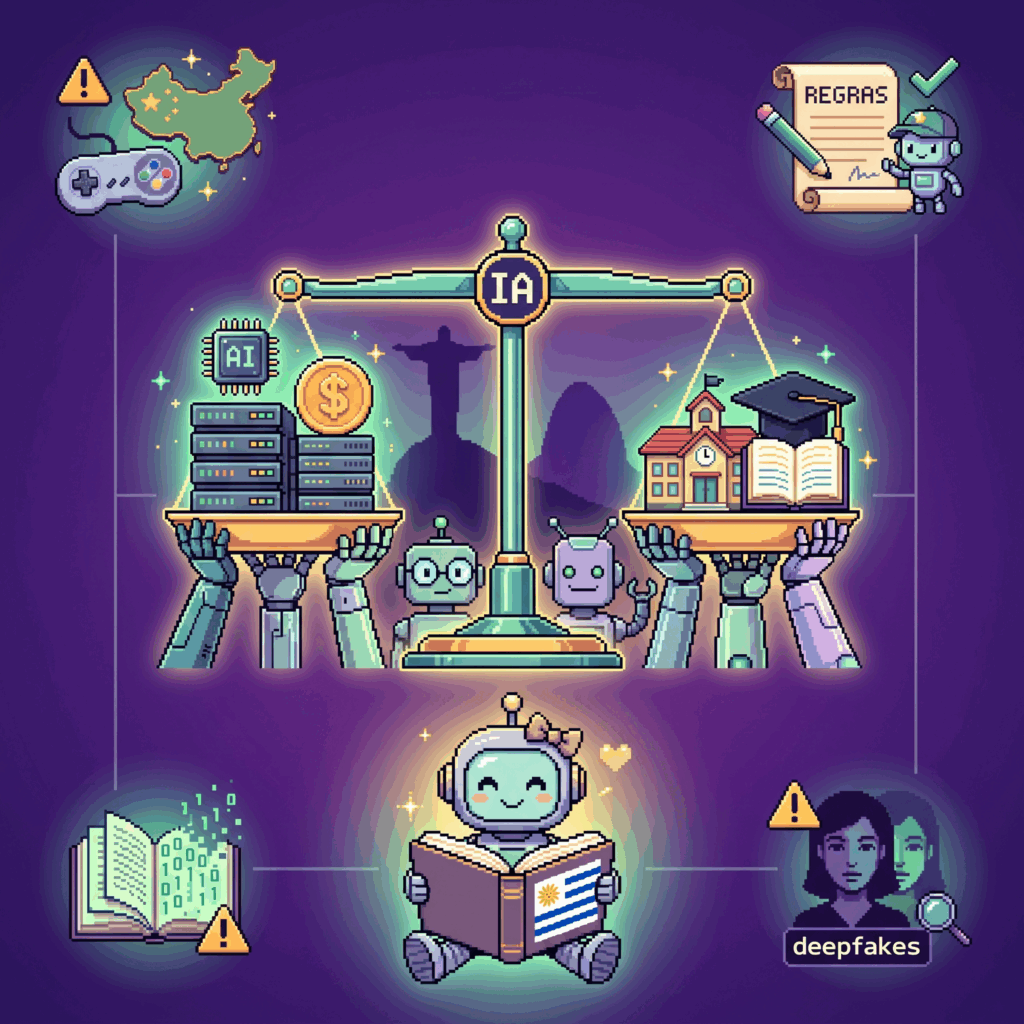
Panels at RIW 2026 point to the connections needed between major investment in technology and the quality of schooling, alongside wider access to digital education.
By José Brito — journalist, founder of Pupa Educação Digital and teacher at the AI and Digital Education Lab of Colégio MOPI.
“We have to point to paths. To say where we want to go. And, unlike what many people think, it is not only the market that determines what innovation is. The experience of the two biggest innovation-producing countries, the United States and China, involves a great deal of public money invested.”
Gabriel Medina — Municipal Secretary of Science, Technology and Innovation of Rio de Janeiro.

[Cover image] Robots hold a scale weighing data centers and AI investment against a school and a book, with Christ the Redeemer behind.
Yesterday was an intense day. I spent hours on my feet in front of the Pupa stand at Start Up Alley, in Warehouse 5 of Rio Innovation Week. A great experience, with plenty of meetings, connections, learning, rounds of new business and, of course, a few thousand steps. By the end of the day my watch had counted more than 12,000. Life goes on, back and forth, as anyone who covers and takes part in big events knows well.
I was also at the EduTech Conference, on the other side of the tracks at Píer Mauá, in the Kobra Warehouse, with the wonderful team from Colégio MOPI, at the invitation of Gisele Lopes, who put together the fantastic curation of that part of the event. I spoke about drafting and implementing policies for the use of artificial intelligence in schools. A room full of educators and administrators committed to a new demand for learning that is shaking the pillars of institutions and school systems. Everyone looking for new ways to move forward with digital transformation without losing sight of the long historical line of progress still needed in the indicators of basic education.
Both agendas are connected by a larger and more complex mission: Rio de Janeiro has been positioning itself as Brazil’s reference city for applied artificial intelligence and urban innovation, stitching together public policy, infrastructure and an active ecosystem of major events.
On one side, Rio AI City, launched by the city government at Web Summit Rio, envisages a mega-complex of data centers in the Olympic Park area, in Barra da Tijuca, with partnerships and investment of US$550 million. Rio.IA, a public innovation hub coordinated by the Municipal Secretariat of Science, Technology and Innovation, connects universities, startups and companies around an agenda of entrepreneurship, digital inclusion and social transformation.
On the other side, this same week brought the results of IDEB, the Basic Education Development Index, which combines student performance assessments with school pass rates. And here is one of the bottlenecks. While Brazil celebrates progress across the historical series at every stage, the figures need careful reading: in Rio de Janeiro, although the indicators for the early and later years of primary school pull the result upward, high school still shows poor performance, well below the national average. Worth reading the report by my colleague Luiza Tenente, at G1.
Among so many important layers in this debate, digital education focused on the ecosystem of professional qualification is where Pupa places itself. We are one of the hundreds of startups that make up the city’s innovation map today, training people to live critically and creatively with artificial intelligence on three fronts — from digital education for young people and adults to accelerating companies with AI-based operational workflows, plus digital culture experiences out in the neighborhoods.
I am taking that sentence I heard from Gabriel Medina at one of his panels as a bet on this new cycle for our city and our state, because infrastructure is only the beginning. Congratulations, Medina! RIW is a success and Rio deserves it! Let’s go together on this journey! Training that qualifies teams in this shifting market is also part of what the investment has to cover.
Enjoy the read!
Sources: Rio AI City — Prefeitura do Rio | Convergência Digital — Rio AI City até 2032 | Rio Innovation Week — Programação | G1 — IDEB do ensino médio 2025 por estados | Agência Brasil — IDEB 2025 | Inep — resultados oficiais

#1 — China Mission 2026: researchers turn conference notes on AI into a digital game
Guilherme Cintra and Thiago Maluta used the Claude and Kimi apps to turn their WAIC travel diary into an interactive experience.
🔗Source: Netlify App e WAIC
#2 — What if teenagers could write the rules for using AI? The result is revealing
A researcher at Columbia University opens up the AI debate with students, talking through privacy, authorship, respect, technology and fact-checking.
🔗Source: LinkedIn
#3 — A leaked WhatsApp conversation turns a dismissal into a court case in Germany, read through the lens of Brazil’s data protection law
The case follows private messages being forwarded to third parties without authorization, and raises the question of how data protection law applies.
🔗Source: G1
#4 — Old books are being destroyed for fast digitization and the training of digital agents
The influencer Bookster explains how a strategy used by big technology companies could compromise rare works of literature, in an environment that has turned hostile to data access.
🔗Source: CNN Pop
#5 — NetLab, at UFRJ, tracks deepfakes of the actress Paolla Oliveira in Meta ads
The survey identifies 198 sensationalist ads with false promises of sexual content, raising the alarm about platforms profiting from illegal advertising.
🔗Source: NETLab Instagram

READING PICK 📚
Book: O LIVRO DOS ABRAÇOS
Author: Eduardo Galeano
Publisher: L&PM Pocket
Year: 2026
Originally published in Spanish as El libro de los abrazos. Available in English as The Book of Embraces (W. W. Norton), translated by Cedric Belfrage with Mark Schafer.
I dropped by Bookworm the other day, a friendly, welcoming bookshop in the Downtown mall. I met Fernanda and Alessandro, the couple who run it. Plenty of ideas ahead. I took the chance to buy one of Eduardo Galeano’s books. I am loving it! Short pieces to read at any hour. Close your eyes and feel a few everyday scenes. Essays about life. And that is what today is about. About memory, utopia and the value of what we want to leave behind in our biographies, in a world that is sometimes hyper-connected and at other times connected to what actually matters. We will still talk a great deal here about what comes out of Rio Innovation Week, but for now we pause for the literary tasting that feeds the soul.

[Book cover] Cover of O Livro dos Abraços, by Eduardo Galeano: dark blue ground, the author’s name in red and the title in yellow.

Thank you for reading Radar Pupa, a newsletter from Pupa Educação Digital. If it makes sense for you, subscribe for free to receive the next editions, and feel free to share these notes on digital culture, news and AI in education.
Preparing people and organizations for digital culture, with strategy and learning.
» SUBSCRIBE ON WHATSAPP!
» pupaedu.digital