


 PT
PT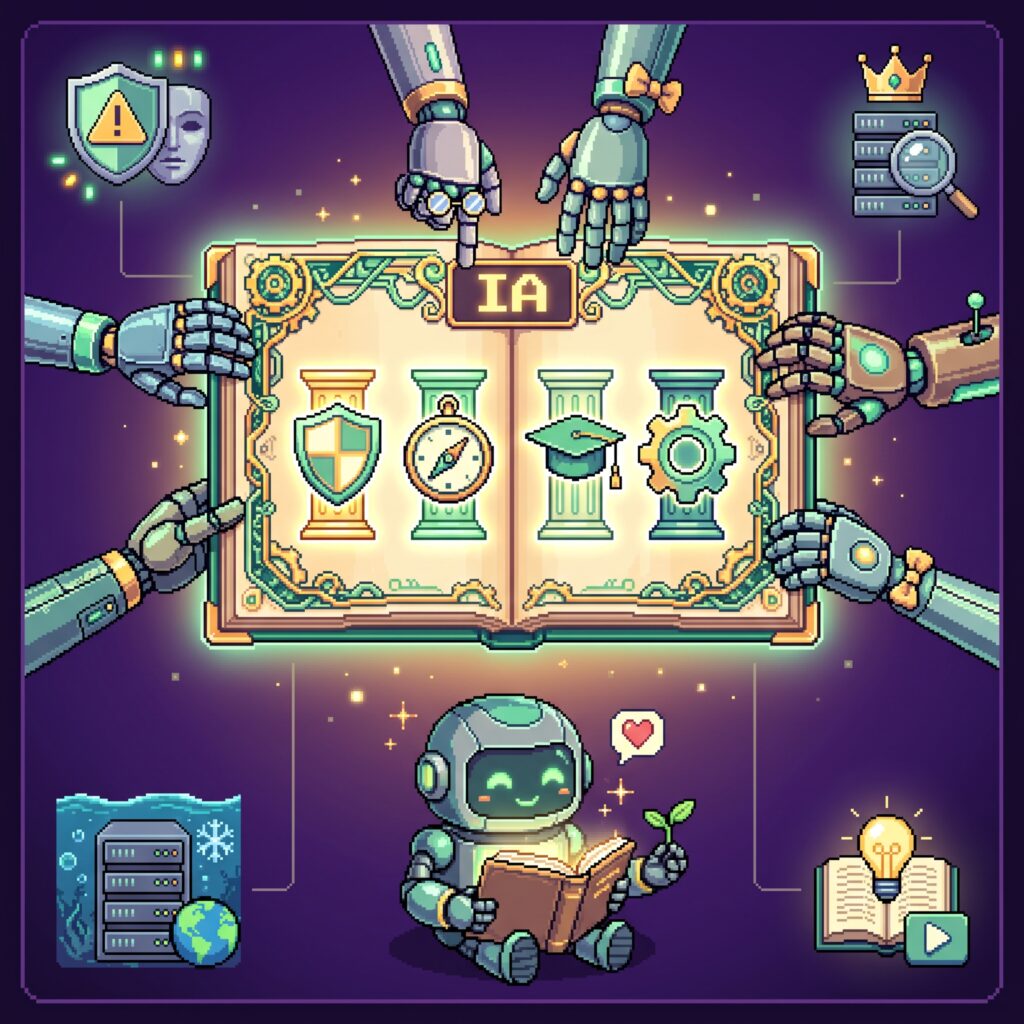
An initiative at Colégio MOPI brings together the work of building a curriculum with digital education, and opens up agendas on citizenship and the future of work.
By José Brito — journalist, founder of Pupa Educação Digital and teacher at the AI and Digital Education Lab of Colégio MOPI, in Rio de Janeiro.
“Learning is, above all, an act of humanity. We do not simply want to use AI: we want the whole community to understand how it works, what it can do and what it will never be able to replace — curiosity, independent thinking and the ability to make meaning in life.”
André Ferreira — coordinator of middle and high school (grades 6 to 12) at Colégio MOPI.

[Cover image] Pixel-art robot hands holding up a glowing book marked “AI”, with a shield, a compass, a graduation cap and a cog.
A student who pastes the assignment prompt into ChatGPT. A family full of questions about what is going on in the school’s WhatsApp group. The teacher who dreams of preparing wonderful lessons with AI but has no idea where to start. Scenes like these are part of many people’s routine, and they are steadily pushing society into exploratory territory with artificial intelligence, digital assistants, their risks, opportunities and consequences.
I am part of this ride. I am a father, a journalist and a teacher. Since the beginning of this year I have been living, in person and in the classroom, the misadventures of life with technology alongside middle and high school students. These are not new problems: they are the latest version of the tensions that Brazil’s Internet Civil Rights Framework tried to address some years ago, that the country’s data protection law regulated more recently, and that the Digital Child and Adolescent Statute and the Education Ministry’s new frameworks for the use of AI in education have now placed in front of us. All of it at once, with the car already moving. Nothing to it.
In this week’s class I shared with the students the example of a professor at a US university who slipped a secret code into an assignment prompt to test whether the work was really the students’ own. The result: more than 90% of the class failed, with copied-and-pasted text. Link to the report here.
Thinking about that example and others, we called on the whole community to build, together, a Policy for the Use of Artificial Intelligence at Colégio MOPI. I had the chance to coordinate a multidisciplinary working group. We opened a Google Form for educators, students and guardians at the Itanhangá and Tijuca campuses. One mother in the group told us: “My son finished his physical education assignment by searching on Gemini, not on Google. The policy needs to reach families.” It was clear right there that the challenge would be far bigger, because we are also in the middle of a change of culture.
From that listening exercise we went into the classrooms: we ran sessions on the Digital Child and Adolescent Statute and AI with every class from grade 6 to the final year of high school. Almost 400 students. We talked about memes, trends, Roblox, the fruit soap-opera videos, “aura” slang, CazéTV and, of course, a few small questions I always put to students: How do you get your information? Where did you see that? Who forwarded it to you? Could it be AI? Have you thought about the context of that information?
In parallel, we took the conversation to families at an event called Escola de Pais — Parents’ School. An online session dedicated to the Digital Child and Adolescent Statute and the use of artificial intelligence, because digital education has stopped being only about protecting our grandparents from internet scams, right? My own parents regularly warn me about the attempts that reach them over WhatsApp. What we have now is a broader, continuous agenda about rights and duties. About skills for the future of work. A future that is being designed at this very moment, with the revision of the digital curriculum in schools and the preparation of companies’ new interns, entrepreneurs and apprentices.
The document born out of that path is organized around four commitments: 1) to protect children and adolescents in complex digital environments; 2) to guide educators in the pedagogical integration of and with AI; 3) to develop autonomous and ethical students; and 4) to qualify the use of AI tools. It engages with the three axes of the computing strand of Brazil’s national curriculum (digital world, digital culture and computational thinking) and also draws on the school’s guiding principles, with the idea of lifelong learning.
We talked a great deal about the importance of reading contexts. A trend is not simply whatever goes viral. A war in the Middle East can move the price of lettuce at the local market. A deepfake in an election year can be built with avatars of people who do not even exist. Online betting advertising explodes during a World Cup on YouTube, and influencers sell health and weight-loss injection pens between one story and the next. Reading this fluid digital ecosystem — knowing where information comes from and whom it serves — is a basic skill of our time. And with AI the process is more complex still. Not by chance, the OECD, which runs PISA, the Programme for International Student Assessment, has already announced that from 2029 there will be new parameters for assessing students’ digital skills. Data from TIC Kids Online 2025, by Cetic.br, show the urgency: 75% of Brazilians aged 15 to 17 used generative AI in the past year, 68% of them for schoolwork.
This debate is also about young people and jobs. I recently watched a TEDx talk by the researcher Amy Bruckman, of Georgia Tech, and she drew an interesting parallel: if AI already does a good part of the work of those starting out in their careers, how are we going to train the mid-career professionals who were already here? That is what I try to do with my students, at home with my daughter, with my parents: to show that a summary can be a good starting point for research, but never the finishing line.
The most important thing is that this process did not end with the publication of the document. It is still alive. An AI policy is something specific to each institution. A journey of listening that can be shared and adapted. It is what we go on doing at Pupa Educação Digital alongside schools, companies and families: talks and training for leadership teams, hands-on workshops and agendas on digital skills, ethics and the future of work. Because preparing the next generations — and also offering reskilling opportunities to teams already in the workforce — is a collective responsibility.
Enjoy the read!
📌 Sources: Política de IA do Colégio MOPI | Cetic.br — TIC Kids Online 2025 | TEDx Amy Bruckman

#1 — Find Pupa at Rio Innovation Week
Pupa will be at Latin America’s largest innovation fair presenting its startup model on three fronts: PUPA EDU (digital education for young people and adults), PUPA MAX (accelerating companies with AI for business) and PUPA LAB (immersive exhibitions and shows on digital culture). José Brito also takes the stage for Colégio MOPI to talk about building a school AI policy collectively.
🔗Source: Rio Innovation Week | Pupa Educação Digital | Colégio MOPI
#2 — China starts cooling AI data centers on the ocean floor
The initiative underlines the global race for leadership in artificial intelligence and aims to raise Chinese efficiency in order to cut the costs of the technology’s energy and thermal demand.
🔗Source: Congresso Abraji — Esquenta com Karen Hao
#3 — The author of Empire of AI joins Abraji’s congress in São Paulo
Karen Hao, author of the bestseller investigating OpenAI’s trajectory and the global impacts of the AI race, joins the program of the 21st International Congress of Investigative Journalism run by Abraji, the Brazilian Association of Investigative Journalism, from July 30 to August 1, in São Paulo.
🔗Source: Revista Carta Capital
#4 — A rise in sexual deepfakes produced by teenagers alarms families
The problem combines accessible technology, a lack of mediation and real risks of violence and humiliation. Take a look at the Common Sense Education report.
🔗Source: Common Sense Education
#5 — UNESCO series offers guidance on digital education with AI
The videos focus on the intersection of digital literacy, ethics and teacher training. Accessible material that translates public policy into classroom practice.
🔗Source: Série UNESCO no YouTube
READING PICK📚
Book: O ALGORITMO DAS FAMÍLIAS
Author: Renata Cafardo
Publisher: Contexto
Year: 2026
Published in Brazil only, in Portuguese. The subtitle reads “como o mundo digital desafia a parentalidade” — how the digital world challenges parenting.

Cover of O algoritmo das famílias, by Renata Cafardo (Editora Contexto): a dark blue background filled with binary digits, the title standing out in white lettering and the subtitle “como o mundo digital desafia a parentalidade” — how the digital world challenges parenting.
I have already put in my request for an autograph. I will be with Renata Cafardo at the coming Abraji and JEDUCA congresses in São Paulo. In O algoritmo das famílias she shows us how parenting today is cut through by algorithms, screens and decisions that no previous generation had to make. It reminded me of the song “Como nossos pais” — “Like our parents” — in Elis Regina’s voice. Even when we try to do things differently, we often stay caught in old patterns, now crossed by other cultural challenges that educate us as well. The book fits the moment we are living like a glove. No simple answers for complex ecosystems. New relationships with our children on the frontier between school, family and technology.

Thank you for reading Radar Pupa, a newsletter from Pupa Educação Digital. If it makes sense for you, subscribe for free to receive the next editions, and feel free to share these notes on digital culture, news and AI in education.
Preparing people and organizations for digital culture, with strategy and learning.