


 PT
PT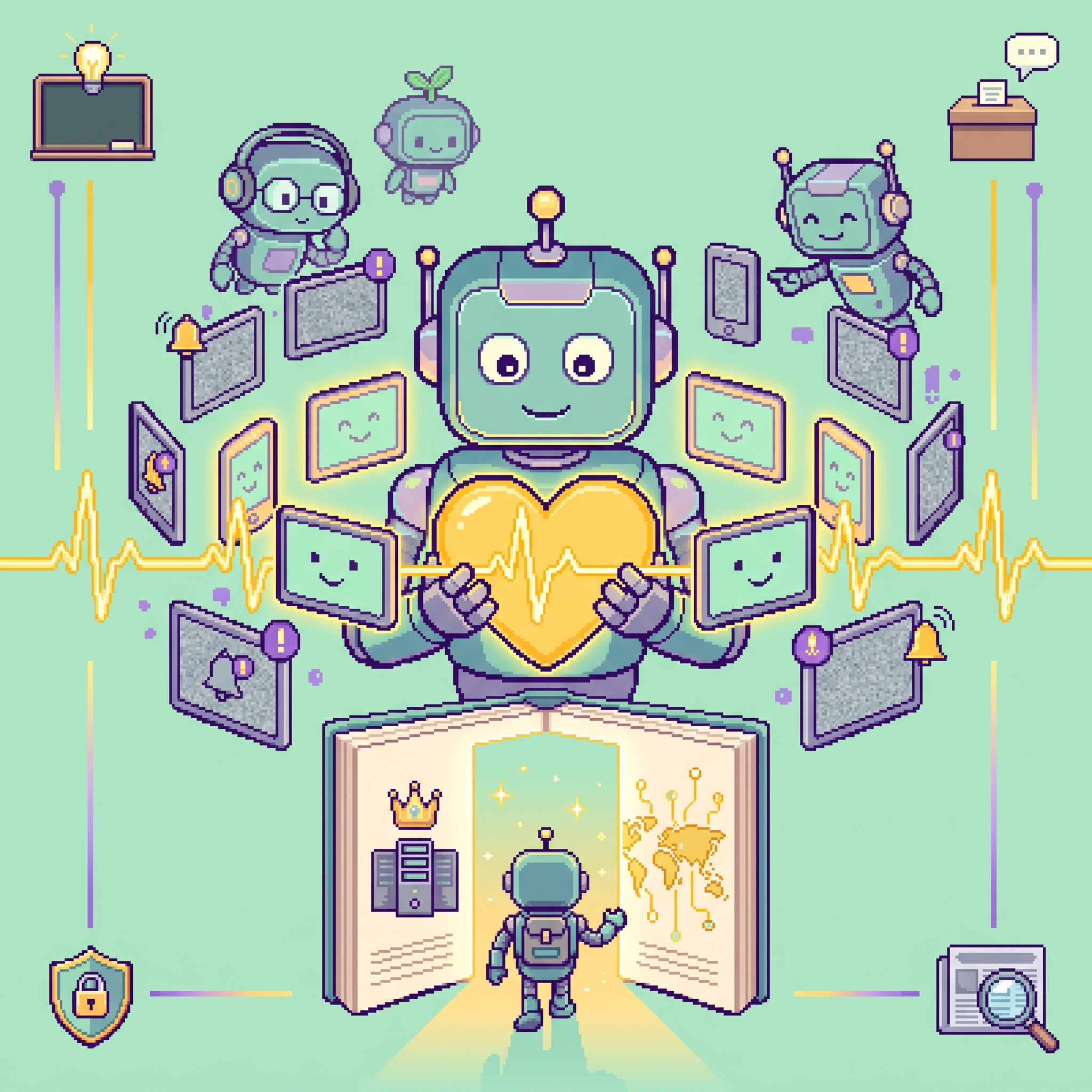
A congress in Rio debates education in the age of digital distraction while society looks for empathy amid scenes of violence, with or without technology.
By José Brito, journalist, founder of Pupa Educação Digital and teacher at the AI and Digital Education Lab at Colégio MOPI.
“The greatest inclusion is the inclusion of desire, of meaning, of purpose. Life does not pulse inside artificial intelligence.”
Carla Tieppo — neuroscientist, PhD in Sciences and speaker at the SinepeRio 2026 Congress, speaking at the 35th Congress of the Rede Sinodal de Educação, in July 2026.

Cover Image generated with AI in Nano Banana. Pixel art illustration on a mint green background. At the center, a smiling robot holds a large golden heart crossed by a heartbeat line, surrounded by phone and computer screens. Below, an open book forms a portal of light through which a small robot with a backpack walks.
I’m writing this edition of Radar Pupa in the middle of two events that marked my Friday morning, as I get ready to take part in the Sinepe Rio Congress, organized by Rio de Janeiro’s association of basic education schools, where I’ll give a talk on Saturday with Colégio MOPI.
The first was a motorcycle accident I witnessed a short while ago while taking my daughter Antônia to school. The second came soon after, when I heard on Bandnews radio the news of the death of a resident of Copacabana, beaten to death after being mistaken for a bicycle thief.
Both shook me deeply. With the traffic at a standstill, we watched life pass right in front of us. The motorcyclist lost his balance and fell. He was on a high-speed road. He stayed lying on the ground and other riders quickly stopped the traffic to help. That collective rush of support in the face of an imminent tragedy, in the fight for a life, stands in contrast to the barbarity of the Copacabana case, where help did not arrive in time and Claudio Rafael Landeiro, 37, was beaten to death by a street watchman and two delivery workers. The headline read: “57 blows in six minutes.”
The quote of the week highlights this search for the meaning of life. It reminds us that despite our direct connection to advanced technology and this whole new context of artificial intelligence, very often the greatest inclusion we need is the inclusion of desire and of meaning. Neuroscientist Carla Tieppo leaves us with a provocation that I believe is essential to face every day when we look in the mirror before leaving home. Where are we? Where do we want to go as a society? What are we doing? With everything happening in Brazil and in the world, with international conflicts, conflicts inside our own homes, violence in traffic, in schools, in the most trivial scenes of everyday life, we need to stop and think about the purpose of all this.
If we are distracted, disconnected from what happens around us, inattentive to the consequences of acts that can change the course of people’s lives and our own future, we lose the ability to feel for another person. And that is the beginning of the end. When empathy is missing, emotion is missing, and so is the power to make a better and more grounded decision in our civic playbook.
This year the congress theme is education in the age of digital distraction. The program includes names such as psychiatrist Ana Beatriz Barbosa Silva, educators Mozart Neves Ramos and Maria Helena Castro, journalist Alexandre Sayad, judoka Flavio Canto, judge Vanessa Cavalieri, philosopher Lúcia Helena Galvão, Vinícius Canedo and others. To talk about neuroscience, mental health and technology is to talk about education for life.
While schools debate students’ attention, other disputes are competing to convince us about the decisions we take. ITS Rio, the Institute for Technology and Society of Rio de Janeiro, created the Boca de IA project, a study of how AI platforms answer questions about elections.
This week OpenAI launched a version of ChatGPT aimed at teenagers. What’s new is a study mode that responds with questions instead of delivering ready-made answers, restrictions on sensitive content, refusal of romantic interactions and parental controls to link accounts.
There is a new course on the Avamec platform: “Digital Safety and Citizenship in the Classroom.” And in São Paulo the BBC forum “Trust is Earned” discussed trust and information integrity in times of synthetic media and threats to journalism.
Enjoy the read! 🙂
📌 Sources: SinepeRio 2026 Congress | Carla Tieppo — 35th Rede Sinodal Congress | Boca de IA — ITS Rio | MEC / Avamec | BBC — Trust is Earned

#1 — SinepeRio 2026 Congress debates education in the age of digital distraction
The meeting takes place today and tomorrow in Barra da Tijuca with more than 40 speakers across panels on neuroscience, mental health, technology, innovation and inclusion.
🔗Source: Congresso SinepeRio | Diário do Rio
#2 — Instead of exit polls, a study reveals how AI platforms behave when the subject is elections
An ITS Rio project monitors how ChatGPT, Gemini, Meta AI, Grok, DeepSeek, Perplexity and Claude answer election-related questions.
🔗Source: Boca de IA | ITS Rio
#3 — Brazil’s Ministry of Education offers a new free digital safety course for educators
Digital Safety and Citizenship in the Classroom has five modules, 40 hours and certification. Produced by SaferNet Brasil with support from the UK Government.
🔗Source: MEC | SaferNet
#4 — OpenAI launches ChatGPT for teenagers with automatic limits and parental control
The version kicks in when the platform identifies users aged 13 to 17, with study mode, restrictions on sensitive content and refusal of romantic interaction.
🔗Source: Instagram / Reels | Notícias ao Minuto

#5 — BBC brings together a debate on credibility and disinformation in São Paulo
The “Trust is Earned” forum was held at the Centro Brasileiro Britânico, with Justice Cármen Lúcia and workshops on the verification methods used by journalism.
🔗Source: BBC | Correio Braziliense
READING PICK 📚
Book: EMPIRE OF AI
Author: Karen Hao
Publisher: Rocco
Year: 2026
To talk about attention and trust is also to talk about what belongs to the so-called difficult conversations of our time. Karen Hao is an MIT-trained engineer and journalist who followed OpenAI closely to reconstruct the turn of an organization born as a nonprofit into a company powered by billions from Microsoft.
It matters to understand that trajectory in order to see what actually sustains the models we use every day. We are talking about computing power, massive data processing and, of course, the attention economy that keeps this wheel spinning faster and faster. When we discuss distraction in the classroom or voting recommendations from a chatbot, we are discussing the visible tip of an infrastructure that was decided somewhere else. Worth reading so we don’t confuse the tools with the decisions we need to make, with sensitivity, at every moment.

Cover of the book O Império da IA, by Karen Hao. Background of horizontal stripes in a purple and green gradient, with the title in large letters inside a white circle with printed-circuit traces, and the Rocco publisher logo at the bottom.
This is Radar Pupa, a weekly newsletter about learning with AI in education, digital culture and the future of work. If it makes sense to you, subscribe for free and share it.
» SUBSCRIBE ON WHATSAPP!
» pupaedu.digital