


 PT
PT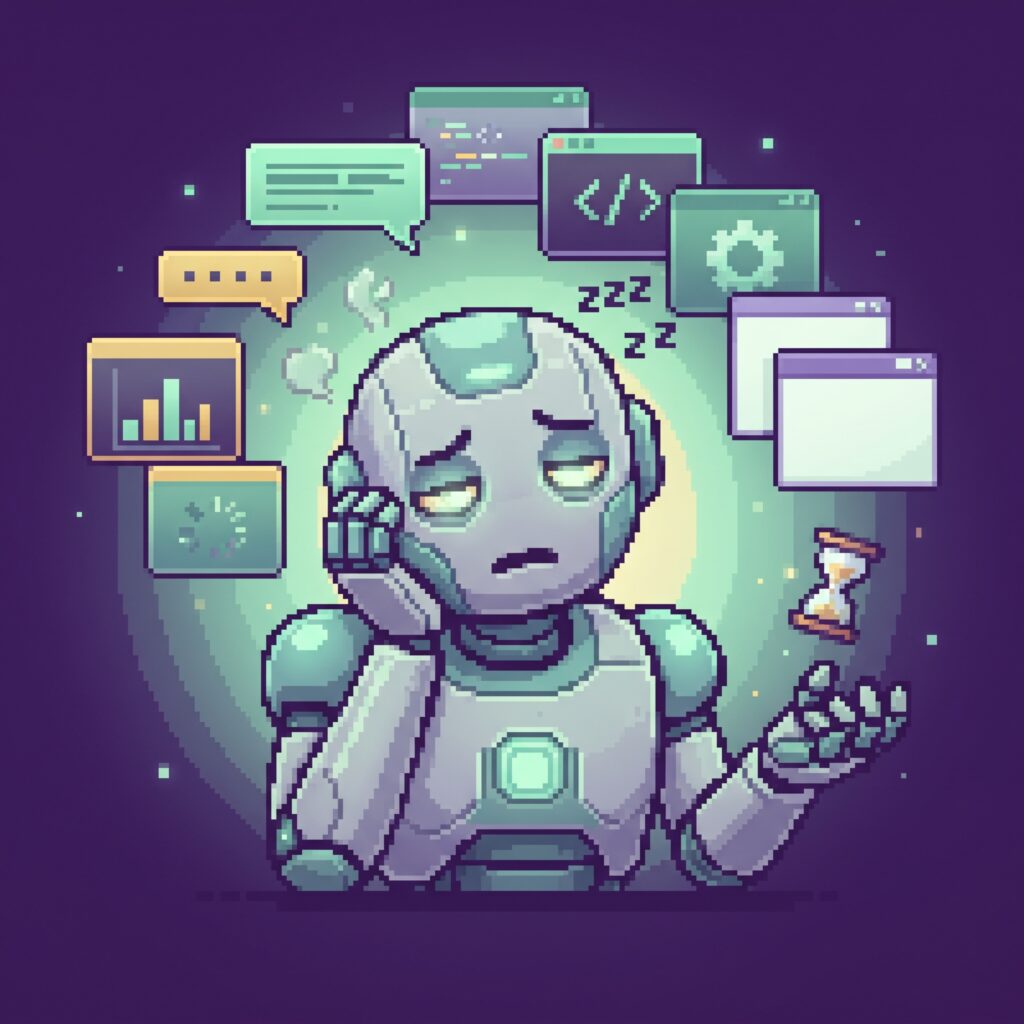
A study published by Harvard Business Review shows that the attention economy is now also measured by the time we spend coordinating digital agents and their tasks.
By José Brito — journalist, founder of Pupa Educação Digital and teacher at the AI and Digital Education Lab of Colégio MOPI, in Rio de Janeiro.
“Technology has always fed the illusion that we are multitaskers, but AI now takes that delusion to another level. The fashion is to coordinate different agents and models in the hope of gaining productivity — at an absurd mental cost.”
Diogo Cortiz — cognitive scientist, professor at PUC-SP and columnist for UOL.

[Cover image] Pixel-art illustration in retro 16-bit style on a dark purple background. At the center, a greyish-green AI robot looks exhausted, eyes half closed and one hand propped against its face, wrapped in a soft mint-green and gold glow. Around it float overlapping task windows, a chat bubble, a chart, a piece of code, a cog and a small hourglass beside its free hand. Palette in purple, mint green and gold, with no text in the image.
Anyone who knows me knows that one of the things I enjoy most is a cup of coffee — espresso, short, no sugar, if possible — to go with a good read. I usually do it sitting on the balcony at home with my tablet in hand, reading the news every morning. I like the design of the print edition of the newspapers in their digital version. Sometimes my subscriber’s copy of Piauí, the Brazilian monthly, is there with me. On other occasions it is the books on the bedside table that are within reach.
That same set of readings does not stop me from observing the world, talking to people, checking other sources — and even relying on an AI agent that puts together a global roundup of the main headlines, cross-references them with fields I am interested in, adds a pinch of advice for my consulting business, and, on top of that, analyzes trends and opportunities in new ventures. None of this by chance. It was given instructions that were exhaustively thought through at some recent point on the timeline of our open relationship with AI tools. Probably while I was having another coffee.
A few years ago, on that same balcony at home, fueled by caffeine and news, I started watching the neighborhood. One day my eyes settled on the bedroom of one of the apartments in the building next to mine. The TV was on. Over time I noticed a pattern. Morning, afternoon and night, the set always on. After weeks of seeing the same scene, I would say to my daughter: wow, that woman’s brain must be frying from watching so much television.
That expression came back to me this week when I read an article by my colleague Diogo Cortiz on LinkedIn about the mental cost we have taken on in supervising AI agents. And about how our brains — depending on exhaustion, iteration, irritation or the pursuit of perfection — can run headlong into a state of “frying”, which is where I imagine my neighbor’s neurons are resting today, in splendid repose. RIP.
It sounds like a joke, but the concept is gaining ground in the debate and is part of a survey by Boston Consulting Group of more than 1,400 workers in the United States. The research examined information on the use of AI at work alongside measures of cognition and emotion. 14% of respondents reported feeling this “fried brain”: an acute fatigue of the mechanisms of attention and working memory, different from burnout, which is emotional exhaustion tied to the volume and the meaning of the work.
What was curious was not the high demand for AI technology, recently pushed by companies across different sectors, but the course correction in how the technology is used. Uber’s CTO, Praveen Neppalli Naga, said that in less than four months the company had consumed everything it had planned to spend on computing and AI for the whole of 2026. What draws attention now is the need for supervision and attention with those same tools across the working day: those who have to monitor closely what the AI does spend 14% more mental effort and feel 12% more fatigue. Using AI for repetitive tasks, for instance, cut burnout by as much as 15%, but intense supervision produced the opposite effect and, in those cases, productivity fell sharply once iteration went from one to more than four simultaneous agents.
The fact is that if we manage to optimize processes with AI, great. That is one path. If we have no need for a shortcut with the technology, better still. Perhaps that is the inflection point of this journey. If we have to go back and forth 30 times to get the agents working properly, we can review how many tasks really do need to be outsourced — and how many just need a coffee break. ☕
📌 Sources: [Diogo Cortiz — UOL Tilt] e [Harvard Business Review — When Using AI Leads to “Brain Fry“

#1 Brain fry: supervising AI is tiring too
Those who supervise AI closely spend 14% more mental effort, and productivity falls from the fourth agent-based tool used simultaneously onward, a study reveals.
🔗 Source: Boston Consulting Group e Diogo Cortiz LinkedIn
#2 New AI course on AVAMEC built on UNESCO frameworks
Brazil’s Ministry of Education launches a free course for teachers of grades 6 to 9, aimed at rethinking classroom practice with the use of artificial intelligence for children and adolescents.
🔗 Source: AVAMEC, Maria Rehder LinkedIn
#3 Waning interest in news is a warning sign for the fight against disinformation among young people
The Reuters Institute’s Digital News Report 2026 points to a convergence between journalism and content creators in the competition for consumers’ attention.
🔗 Source: Reuters Institute e Maria Carvalho LinkedIn
#4 Amy Bruckman and the reinvention of the classroom with AI
How do you train mid-career professionals if, at the very start of the new generation’s working life, AI already does a good part of the work for them?
🔗 Source: Youtube TEDx
#5 NotebookLM joins the short-video wave with a new audiovisual feature for text documents
Google has launched Short Video Overviews in NotebookLM, generating vertical videos of up to 60 seconds with AI narration and illustrations. Worth a try.
🔗 Source: Café com bytes
READING PICK 📚
Book: GRANDE SERTÃO: VEREDAS [70th anniversary special edition]
Author: João Guimarães Rosa
Publisher: Companhia das Letras
Year: 2026

Woven-fiber slipcase of the 70th anniversary edition of Grande Sertão: Veredas, with a colorful weave on the spine.
Published in English as The Devil to Pay in the Backlands (1963, translated by James L. Taylor and Harriet de Onís). A new English translation by Alison Entrekin has been announced.
I have already ordered my gala edition. It arrives in a few days. I was moved by the anniversary of one of the great works of Brazilian literature and, as I do every week, I try to draw some parallel here between what is happening in the world of technology and the reading that crosses our path. Grande Sertão: Veredas is the opposite of what we are seeing out there. The opposite of any automatic summary, of a 60-second video, of anything digital agents are capable of delivering. It is a work that gives up what it has to offer only to those willing to stay with it, without haste and without shortcuts. It takes time and full attention to enjoy and understand the memories of Riobaldo and Diadorim, and their umbilical bond with the landscape of the sertão, Brazil’s semi-arid backlands. Pure Brazil in the pages of a story. The commemorative edition brings previously unpublished passages about the master Guimarães Rosa, essays and drafts that preceded the novel’s final form, with reflections from illustrious readers such as Mia Couto, Milton Hatoum and Itamar Vieira Junior.
Thank you for reading Radar Pupa, a newsletter from Pupa Educação Digital. If it makes sense for you, subscribe for free to receive the next editions, and feel free to share these notes on digital culture, news and AI in education.
Preparing people and organizations for digital culture, with strategy and learning.
» pupaedu.digital