


 PT
PT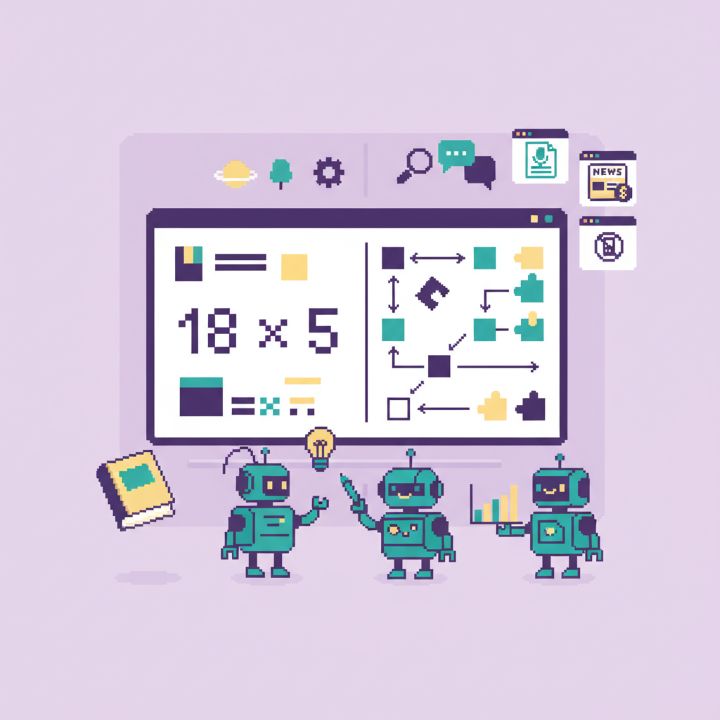
As AI and computational thinking gain ground, mathematical reasoning takes center stage at Brazil’s 9th International Education Journalism Congress
Photo by: JEDUCA
Hi everyone! Wishing you a great week and some good reading ahead.
By José Brito, journalist and founder of Pupa Educação Digital
“People with a growth mindset show greater brain activity when they make mistakes. When we engage with math, we activate multiple neural pathways.”
Jo Boaler, Professor of Mathematics Education at Stanford University and co-founder of Youcubed
I had the opportunity to meet Jo Boaler at the 9th International Congress of Education Journalism, held this week in São Paulo. The event is part of the annual agenda of JEDUCA—the Brazilian Association of Education Journalists—founded in 2016 to support journalists through training, collaboration, and international gatherings like this one, which brought together over 500 participants in two days.
In her keynote talk, Boaler challenged the audience with a simple mental math exercise: What’s 18 x 5?
A moment of silence followed. Nervous smiles. Raised eyebrows. “That’s easy… but what’s the catch?” she seemed to be asking.
She sipped water and gave everyone two minutes to solve it—no calculators, no notes, just brainpower.
I happened to be sitting near Antônio Gois (education columnist at O Globo) and not far from Renata Cafardo, (education reporter for Estadão and current president of JEDUCA). Also in the audience were Camilla Salmazi, Paulo Saldaña, Tatiana Klix, Thaís Borges, Marta Avancini, Amanda Cieglinski, Cintia Gomes and Luiz Fernando Toledo, —journalists deeply rooted in the social sciences and education reporting, but all well-acquainted with the daily presence of numbers in their work.
The silence turned out to be part of the point. Boaler wasn’t just testing our math skills—she wanted to observe how we approached the problem. Did we visualize it? Estimate? Break it into parts?
Let me clarify: she said “algorism,” not “algorithm.” Yes, those numerical symbols from 0 to 9—not the trendy AI term that dominates headlines. In this exercise, the method was the message. I mentally arranged the numbers on an invisible page: 5 times 8 is 40… carry the 4… and so on, the old-fashioned way.
Others used rounding strategies or estimation. Some got it wrong. At lunch, everyone shared their approaches—and then Jo Boaler revealed seven other ways to solve the same “simple” problem. What started as basic math was now elevated to a complex mental operation, or maybe even an insight into how we learn.
Her point? It’s not just about improving Brazil’s PISA scores (Brazil scored 379 in math in the 2022 edition, far below the OECD average of 472). It’s about rethinking how we teach math—with more creativity, abstraction, playfulness, and connections to everyday life. From childhood games to musical parodies, science experiments to art projects, we can swap rote memorization for deeper, logic-based learning that supports real-world empowerment.
And here’s the kicker: the next PISA will also assess digital skills.
Oh—and the answer to 18 x 5? It’s 90.
Enjoy the read!

#01 Jo Boaler, Stanford professor, highlights the importance of logical reasoning in math education
Link [Jeduca] Foto: Tiago Queiroz

Link [O Globo] Foto: André Mello
Link [Nic.br] Foto: Nic.br
Link: [Jornal Nacional] Foto: reprodução JN
Link [Canal Tech] Foto: Marcelo Salvatico
his one came with a dedication and a lot of heart. I received the book from Professor Noslen Borges during a coffee break at the JEDUCA Congress. I finished it on the short flight from São Paulo to Rio.
In a moment when we reflect so much on math education, it’s good to remember that our beloved Portuguese language also holds its fair share of puzzles—from crasis to grammar rules, punctuation, and more.
Noslen, with over 7 million followers on social media, has become a voice for education in Brazil. Once a classroom teacher, he now explores new ways of engaging learners and building narratives about our spoken and written language. His book’s foreword is by Luís Roberto Barroso, President of Brazil’s Supreme Court, who recently joined Noslen in events about media literacy and digital policy.
»“Portuguese Without Embarrassment”
Author: Noslen Borges, com prefácio do Ministro Luis Roberto Barroso
Publisher: Citadel Grupo Editorial
2025
